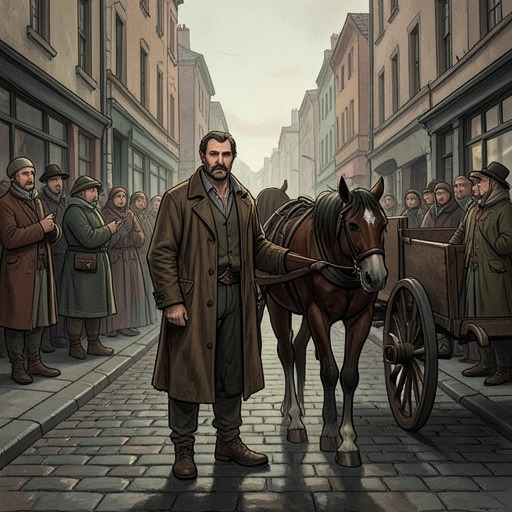
Jerry’s Last Night Driving a Cab and His Retirement
Black BeautyJerry Barker’s last New Year’s night as a cab driver turns an ordinary late hire into the end of his working life in London. A long wait in bad weather aggravates his already troubling cough; his serious illness forces him to give up cab work, and the family’s plans to move to the country bring a second parting for Black Beauty, who is left behind despite the family’s affection for him.
The holiday’s demands
For cab drivers and their horses, Christmas and New Year bring no holiday. Parties and entertainments keep cabs in demand late into the night, while drivers and horses may have to wait outdoors for hours. The contrast between the festivities indoors and the people and animals waiting outside gives the episode its social setting: the holiday that brings pleasure to passengers can mean an extended working night for those who carry them.
Jerry’s household depends on cab work, but his care for Black Beauty distinguishes his driving from the harsher treatment the horse has encountered elsewhere. As owner and driver, Jerry has a direct interest in not overworking his horse, and he is also described as a good man. During Christmas week, however, there is a great deal of late work, Jerry’s cough is already bad, and Black Beauty takes most of the evening duties. Jerry is also concerned that Hotspur might catch cold. The strain is present before the New Year’s hire begins, even though the household continues to care for both horses.
The New Year’s wait
On New Year’s evening, Jerry takes two gentlemen to a house in one of the West End squares. They ask him to return at eleven, warning that the card party might run a few minutes late. Jerry arrives punctually as the clock strikes eleven, but the passengers do not come out. The wait continues through the quarter-hour chimes and past midnight. When Jerry asks the servant at half-past twelve whether the cab will still be needed, he is told to stay because the party will soon be over.
The weather has turned to driving sleet, and there is no shelter. Jerry adjusts one of Black Beauty’s cloths over his neck, walks up and down to keep warm, and then sits in the cab for some protection. His coughing worsens. At a quarter past one, the two gentlemen finally emerge, having kept the cab waiting for two hours and fifteen minutes. They give Jerry a destination nearly two miles away; when they reach it, they complain about the charge rather than acknowledging the delay. Jerry charges what is due for the waiting time and does not reduce the fare. The payment is hard-earned, following a wait that has cost both driver and horse rest in severe weather.
The account makes the passengers’ late return consequential rather than incidental. Jerry’s punctuality and willingness to remain available are met with an extended delay and resentment when the fare reflects it. The scene also recalls the broader pressure on cab workers: low fares, fixed costs, and long hours can make it difficult for drivers to refuse work without jeopardizing their living. Jerry’s circumstances are not identical to those of drivers who hire their cabs, but the night shows that even a conscientious owner-driver is not protected from the demands of the trade.
Illness and recovery
When they get home, Jerry can hardly speak. Polly Barker asks what she can do, and he asks her to warm food for Black Beauty and prepare gruel for him. Despite his own condition, Jerry rubs the horse down and brings extra straw for his bed. Polly then brings Black Beauty a warm mash. The care moves in both directions: Jerry has looked after his horse through a difficult night, and Polly helps ensure that the horse is settled while her husband is unwell.
The following morning, Harry Barker comes to clean and feed the horses and sweep the stalls. He works quietly, without his usual whistling or singing. At noon, Dolly Barker accompanies him; she is crying, and Black Beauty learns from their conversation that Jerry is dangerously ill. The doctor has diagnosed bronchitis and considers the case serious. For two days, the family remains distressed, while Harry and sometimes Dolly attend the stable and Polly stays with Jerry, who must be kept quiet.
Governor Grant comes to ask after Jerry. Harry reports the diagnosis and the doctor’s uncertainty about whether Jerry will survive the night. He also explains that Jerry has a better chance than many patients because he does not drink: the doctor believes that, with the fever so high, a drinking habit would have worsened his prospects. This detail makes Jerry’s temperance a practical factor in his recovery, not merely a personal virtue. Grant offers encouragement, and, as Jerry gradually improves, he provides tangible help by taking Hotspur out for a week or more, giving the horses rest while Jerry cannot work.
Retirement and departure
Jerry’s recovery does not mean a return to his former livelihood. The doctor warns that he must never resume cab work if he wants to live to old age. The children discuss how their parents will manage and how they themselves might contribute. Their prospects change when Dolly brings news from Mrs. Fowler: the family can move near her, into an empty cottage with a garden, henhouse, and apple trees. When Mrs. Fowler’s coachman leaves in the spring, Jerry may take his place. The nearby households may also offer work for Harry and other members of the family, and Dolly will have a school to attend.
The move is settled for as soon as Jerry is well enough, and the cab and horses are to be sold as soon as possible. The decision offers a safer future for Jerry, but it makes Black Beauty’s separation from the family inevitable. Three years of cab work, even under Jerry’s comparatively considerate care, have diminished his strength. He has not been as happy since leaving Birtwick, and he no longer feels that he is the horse he once was. Jerry refuses to let just anyone buy him for further cab work, and Governor Grant promises to find him a comfortable place. Grant takes Hotspur himself.
Jerry is not yet allowed out when the family leaves, so Black Beauty never sees him again after that New Year’s Eve. Polly and the children come to say goodbye. Polly wishes they could take the horse with them, lays a hand on his mane, and kisses him; Dolly kisses him too, while Harry strokes him in silence. Black Beauty is then led away to his new home. The departure resolves Jerry’s illness by taking the family out of cab work, but it closes the horse’s life with the family he regards as his dearest master.
Significance
The episode links an individual retirement to the conditions of urban cab work. Jerry’s care for Black Beauty is real, yet affection cannot erase the fatigue accumulated through years of service or prevent a late holiday hire from extending an already demanding night. The family’s move is both a consequence of Jerry’s illness and an opportunity made possible by Mrs. Fowler’s offer and Governor Grant’s practical support.
For Black Beauty, the ending is double-edged. The horse is spared an immediate sale to an unknown cab owner, because Jerry and Grant seek a comfortable placement; nevertheless, the promise of care cannot keep him with the people who have treated him as family. The final goodbye gives material force to the costs of retirement: Jerry leaves a trade that has become unsafe for him, while Black Beauty’s own declining strength means that even kindness cannot restore their former shared life.